Given the astounding expectations piled upon the National Stadium, I’m surprised it hasn’t collapsed under the strain.
More than 90,000 spectators will stream through its gates on Friday for the opening ceremony of the Olympic Games; billions are expected to watch the fireworks on television. At the center of it all is this dazzling stadium, which is said to embody everything from China’s muscle-flexing nationalism to a newfound cultural sophistication.
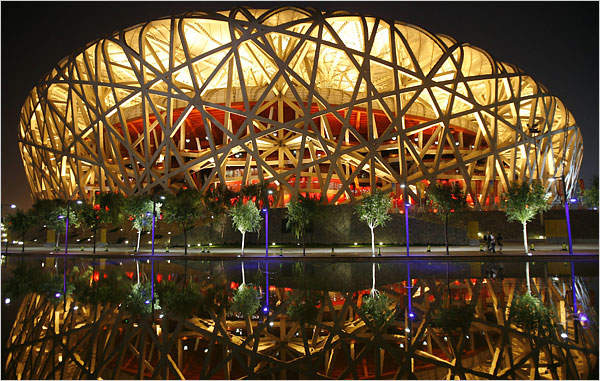
Expect to be overwhelmed. Designed by the Swiss architects Jacques Herzog and Pierre de Meuron, the stadium lives up to its aspiration as a global landmark. Its elliptical latticework shell, which has earned it the nickname the Bird’s Nest, has an intoxicating beauty that lingers in the imagination. Its allure is only likely to deepen once the enormous crowds disperse and the Olympic Games fade into memory.
Great architecture can never be fully conveyed through a television screen, of course, and it saddens me that so many Americans will experience the building only via satellite. In a site for mass gatherings, Herzog and de Meuron have carved out psychological space for the individual, and rethought the relationship between the solitary human and the crowd, the everyday and the heroic. However the structure attests to China’s nationalistic ambitions, it is also an aesthetic triumph that should cement the nation’s reputation as a place where bold, creative gambles are unfolding every day.
Until now, the number of memorable Olympic stadiums could be counted on one hand. There is Berlin’s 1936 Olympic Stadium, by Werner March, with its imposing ring of stone columns, a symbol of fascism’s absolute disregard for the individual. In an intentional counterpoint, Günter Behnisch and Frei Otto designed transparent tentlike roof canopies for the 1972 Olympic Stadium in Munich, daring in their structural innovation. And there is the elegant ring of slender Y-shaped columns supporting Pier Luigi Nervi’s Palazzetto dello Sport, which was a minor venue at the 1960 Games in Rome.
Herzog and de Meuron were chosen for the Beijing project partly on the strength of their design for the 2005 Allianz Arena in Munich. Clad in puffy, translucent panels made of a high-tech plastic, that arena’s doughnut-shaped form seems to swell from pressure within. (Herzog compares it to a boiling pot.)
During sports events, it glows with energy: the hue of its translucent skin shifts from game to game with the colors of the teams. Inside, the steep pitch of the seats creates the impression that the 70,000 spectators are coiled tightly around the field. It’s a masterly way to choreograph the focused hysteria of a soccer match.
But in Beijing, the architects were clearly striving for something more heroic. The centerpiece of a vast Olympic park in the northern reaches of Beijing, the stadium is raised on a mound of earth to give it a more monumental presence. Its matrix of crisscrossing columns and beams was conceived as a gargantuan work of public sculpture.
Viewed from a distance, the contrast between its bent steel columns and its bulging elliptical form gives the stadium a surreal, moody appearance, as if it were straining to contain the forces that are pushing and pulling it this way and that. Philosophically, it suggests the tensions just beneath the surface of a society in constant turmoil.
Working with the engineering firm Arup Sport, the architects designed a series of cantilevered trusses to support the roof, which shades the seats. A secondary pattern of irregular crisscrossing beams is woven through this frame, creating the illusion of a gigantic web of rubber bands straining to hold the building in place.
But the stadium’s exterior also sends other messages. Herzog and de Meuron came of age when architects had begun striving to break down the purity of late Modernism, which they saw as a kind of authoritarianism. By turning to asymmetrical forms and mysteriously translucent materials, they challenged that rigid, aesthetic ethos.
 Posted By: Anna King
Tuesday, August 5th 2008 at 2:05PM
You can also
click
here to view all posts by this author...