A true chamber music festival can be only as good as the performance space it occupies. By definition, chamber music is meant to be experienced up-close, in the salons of old or the intimate recital halls of today.
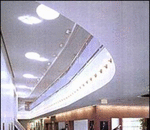
The five-week Santa Fe Chamber Music Festival, now in its 36th summer season, is fortunate to have St. Francis Auditorium as its principal setting. The attractive and acoustically vibrant hall is part of the New Mexico Museum of Art, located just off the tree-filled main plaza in the center of this pleasant city of adobe charm and aggressive tourism.
Modeled on a Pueblo mission church, St. Francis Auditorium opened in 1917, part of the Pueblo revival period in Santa Fe architecture. A series of colorful murals depicts scenes from the life of St. Francis and the good works of Franciscans in New Mexico. A row of carved-wood ceiling beams are both imposing and beautiful.
The festival, which this summer offers 39 concerts of 100 works, including premieres, rarities and favorites, also presents some programs in the city’s 821-seat Lensic Performing Arts Center, an elaborately decorated vaudeville house from 1931, renovated in the late 1990s. While here, I caught two concerts at St. Francis Auditorium: an appealing Schumann program on Thursday at noon and a fascinating contemporary-music program featuring Anssi Karttunen, a brilliant Finnish cellist, early on Friday evening.
The main draw for music-minded visitors to the city each summer is the respected Santa Fe Opera, something well understood by the pianist and composer Marc Neikrug, the chamber music festival’s enterprising artistic director. So the festival wisely schedules concerts that do not conflict with the opera company’s performances.
The noontime series, with concerts lasting about an hour, is popular with tourists. And most evening concerts begin at 6, leaving plenty of time for a postperformance dinner and enabling voracious classical music buffs (and critics) to drive the few miles north to the Santa Fe Opera in time for a production.
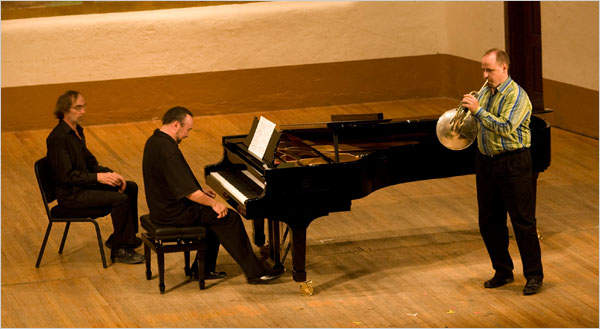
Some 90 performers are taking part in the chamber music festival this summer, from well-known international artists to valued local musicians, like Peter Ulffers, principal hornist of the New Mexico Symphony Orchestra, who also plays with the Santa Fe Symphony and the Santa Fe Opera.
Accompanied by the pianist Jon Kimura Parker, Mr. Ulffers opened the Schumann program with the Adagio and Allegro in A flat. The piece begins with the instruments conversationally trading the phrases of an amiable melody, then segues into a rousing main section. Though a few of the virtuoso flourishes for horn gave Mr. Ulffers a little trouble, he played over all with vitality and character.
Mr. Parker played beautifully for Cynthia Phelps, the superb principal violist of the New York Philharmonic, in “Märchenbilder,” a suite of four moody, fanciful pieces from Schumann’s curious late period. Ms. Phelps brought lyrical nobility and lush tone to the melancholic final piece.
In a group of five Schumann songs, it took the soprano Arianna Zukerman time to warm up. At times her bright voice was shaky in sustained tones. But at best, her singing was strong, direct and sensitive. Mr. Neikrug provided stylish accompaniments. He also accompanied the formidable cellist Ronald Thomas in a rhapsodic account of the well-known “Fantasy Pieces” (Op. 73), which ended the program.
Mr. Karttunen’s concert on Friday offered diverse contemporary works for solo cello, with a few short exceptions: three tango-tinged pieces for three cellos by the Argentine composer Pablo Ortiz. Mr. Karttunen began with a recent solo work by Mr. Ortiz, “Manzi,” quirky music with pungent harmony and Baroquelike passages that surely pay homage to Bach.
Luigi Dallapiccola’s arresting “Ciaconna, Intermezzo e Adagio” (1946), for cello solo, is the kind of visceral music that may cause listeners who fear the term “12-tone” to have an epiphany. Berio’s “Sequenza XIV” (2002) ingeniously explores the sound possibilities of the cello, including long stretches in which, by tapping on the body of the instrument and rapping the strings, the cellist evokes Sri Lankan drum rhythms. Mr. Karttunen played both works commandingly.
The Finnish composer Kaija Saariaho, whose “Adriana Mater” is receiving its American premiere production at the Santa Fe Opera this summer, was in attendance for Mr. Karttunen’s performance of her “Sept Papillons” (“Seven Butterflies”), from 2000, a suite of short (roughly a minute each), capricious, vividly colorful fantasy pieces in the spirit of Schumann. Each explores a different cello technique or musical element, like fluttering rhythmic riffs or eerie, thin tunes hovering over weird pedal tones.
Leaving the auditorium, the audience came upon a mariachi band inviting people to a crafts fair in the plaza. From Saariaho to mariachi: a typical day in Santa Fe during the summer festival season.
The festival continues through Aug. 25. Information: (505) 982-1890 or (888) 221-9836; santafechambermusic.org.
 Posted By: Anna King
Tuesday, August 5th 2008 at 2:07PM
You can also
click
here to view all posts by this author...