Newburgh has entered the final stage of its Rites of Passage with the rebirth of its African-American Day Parade and Multi-cultural Festival
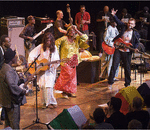
The 1950’s "All American City" is having an African-American Day Parade and Multicultural Festival for the first time in twenty-seven years. The parade will take place on Saturday, September 6, 2008. After marching down Renwick Street and across Liberty Street, the parade will end at the recently constructed Audrey Carey Park between Third Street and Farrington Street where the festivities will begin. The parade and festival will last from noon until 10 p.m.
Newburgh regrettably changed its 1952 title of "All American City" to "New York State’s Most Violent City" in 2002. Once upon a time Newburgh was developing into the next Manhattan, the place where everyone wanted to be.
Even prior to 1952, Newburgh was a place where a lot of history was created, especially for African-Americans. Research conducted by Sergeant First Class Eric Hunt demonstrates that African American soldiers from Newburgh, and its surrounding areas, have fought in every American war from the Revolutionary War to today in Iraq, Private Peter P. Woods, Private James Dubois, Corporal Joseph Bell, and Staff Sergeant Beverly Melvin just to name a few. The A.M.E. Zion Church in the City of Newburgh has a plaque dedicated to the colored soldiers from Orange County that served in the Civil War with the names of the men from Newburgh listed. Many of Newburgh’s current citizens are the descendents of these, and other, great soldiers.
During World War I, the City of Newburgh had a parade for the African-American men who were called up to serve. This not only, brought pride and recognition to the tradition of African-American soldiers serving their community and country, but to the city as well.
Much to the community’s disappointment, the next African-American Parade did not occur in Newburgh until 1977. People in the Newburgh community have originated from a long history of influential African-Americans. During the 1960’s and 1970’s, this was beginning to be forgotten as Newburgh’s economy declined and its image tarnished. This was due in part to the end of the ferry, but mostly to urban renewal. Fortunately, some of Newburgh’s key players in the community, like Reverend Sylvester McClarein, Reverend Herman Hubbard, Mr. Harvey Burger, and many others, and longstanding businesses, like Newburgh Park Motors, Finkelstein, Mauriello, and Kaplan, Orange Ford, Colandrea, Smith’s Plumbing and many others, realized the need for inspiration and change, which could be found in the reemergence of the African-American Parade.
In an interview Mrs. Rebia Spearman, a fifty year resident of Newburgh and one of the original coordinators of the 1977 parade, said that one memory of Newburgh that stands out in her mind over the years since she has been here is "the African-American Day Parade [in 1977] because it brought the city together in the 70’s." With the local block parties, the African-American Day Parade "kept the community together" and made the City of Newburgh community "like a family."
Despite the effort, the 1977 African-American Day Parade’s unification did not last long and Newburgh continued its downward spiral. According to New York House Magazine, "In 2002, the State Department of Criminal Justice Services and Uniform Crime Reporting released a study showing that Newburgh was the most violent city in New York State - for three years running."
Newburgh’s African-American residents have been fighting for their rites of passage and the African-American Day Parade and Multicultural Festival is the last phase of re-incorporation. The first phase of separation occurred with urban renewal and the second phase of transition is still in effect, and causing selfishness and a lack of focus. Without a sense of community and belonging, Newburgh’s African-American inhabitants have become misguided, and consequently self-destructive.
The former and second black female, mayor of Newburgh, Mary L. Crabb, said that one thing that people need to know about Newburgh is that "it’s a multiracial city with a lot of art and history." What has been shall be again. So, on September 6, 2008 the people of Newburgh will have a chance to celebrate its positive history and come together to embrace each other’s cultural differences once again.
 Posted By: Maria Monica Rocha
Wednesday, August 6th 2008 at 8:41PM
You can also
click
here to view all posts by this author...