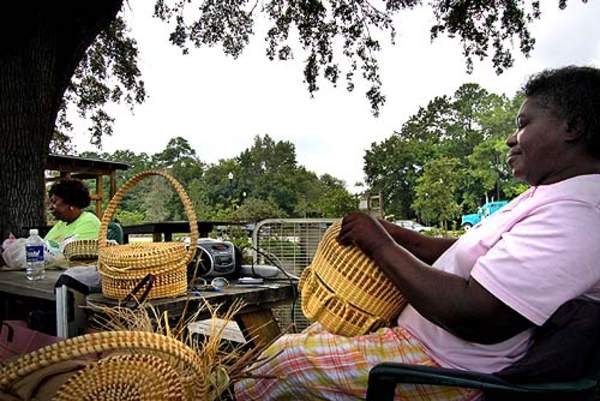
Looping strips of palmetto fronds through coiled sweetgrass is slow poison.
Squinting in concentration ruins the eyes, forcing a nail bone through the grass wrecks the hands and bending over the creations cripples the back. But Elijah Dumas of Mount Pleasant can't stop weaving, he said, sitting at Charleston's downtown Market.
"It's like an addiction," Dumas said.
Perhaps that's why the art has endured for hundreds of years in the Lowcountry and thousands in Africa. Roots of the Lowcountry and African basket art will be the focus of a traveling exhibit opening Friday at the Gibbes Museum of Art in downtown Charleston.
"Grass Roots: African Origins of an American Art," a collection of more than 200 baskets from South Carolina, Georgia and Africa, and African artwork will call the second floor of the Gibbes home until Nov. 30.
The exhibit was created by New York's Museum for African Art in cooperation with the Avery Research Center for African-American History and Culture at the College of Charleston and McKissick Museum at the University of South Carolina. While the New York museum waits for a new building, "Grass Roots" will travel for two years, ultimately starring at the museum's opening in Harlem.
The fact that the exhibit begins its trail at the Gibbes is important, says Marla Loftus, the museum's director of communications, not only because the American basket tradition has its roots here, but also because the Gibbes is an art museum.
"This is art," Loftus says. "We're recognizing the true art form."
Sweetgrass baskets started as a tool made by slaves on Lowcountry rice plantations in the late 1600s, said Dale Rosengarten, a curator and historian of special collections at the College of Charleston Library, and became objects of admiration more than 100 years ago.
They were a visible symbol of African-American culture in the Charleston area, Rosengarten said. Work baskets faded along with rice plantations, but esthetic sweetgrass baskets endured.
Basketmakers began selling their wares to merchants for wholesale prices in the early 1900s, she said. The opening of the Cooper River bridge between Charleston and Mount Pleasant and the paving of U.S. Highway 17 in Mount Pleasant brought buyers closer to basketmakers' homes and put more money in weavers' pockets.
In the book "Grass Roots: African Origins of an American Art," which accompanies the exhibit, Rosengarten writes that soon after the highway's paving, Edna Mae Rouse, a Boone Hall Plantation caretaker, and another person began setting up baskets and tomatoes for sale on a table along the highway. Another woman, Betsy Johnson, hung baskets outside her store probably creating the first basket stands on what's now called Sweetgrass Basket Makers Highway.
Adeline Mazyck's family had a stand along the highway that was relocated to Mount Pleasant Towne Centre.
Her mother taught her to fashion baskets from sweetgrass and palmetto leaves when she was 6 or 7 years old, Mazyck recalls while weaving under an oak tree.
"You wanted to learn, but after you learn, you wish you hadn't because they (family members) make you after that," Mazyck said.
Mazyck said she and her siblings, including all her brothers except for one, learned to make baskets, but now only the women in her family carry on the tradition.
Rosengarten said that when it comes to weaving, most often the artists are referred to as sweetgrass basket ladies, but men always have been an important part of basket heritage.
Most often men have been involved with the gathering of materials, but they also are the makers.
Dumas learned to coil baskets from his grandmother, and though he's had other jobs over the years, at 45 he's turned solely to making baskets, preferring the Charleston City Market location to Highway 17 in the hopes of attracting true art collectors.
The baskets, which can take days, even months, to create, are not cheap souvenirs. A man traveling through the Market last week picked up a small basket, saw the $240 price tag and dropped it, exclaiming in surprise.
People not able to collect might find attending the exhibit more palatable. The Gibbes has organized a series of events to coincide with the exhibit, including an opening party 7-10 p.m. Sept. 4.
For more information on the exhibit and its events, go to
http://gibbesmuseum.org/visit/calendar.php... Reach Jessica Johnson at 937-5921 or jjohnson@postandcourier.com.
 Posted By: Anna King
Thursday, August 28th 2008 at 1:39PM
You can also
click
here to view all posts by this author...